Preserve health
Reduce avoidable risk, improve prevention delivery, act earlier when evidence supports it, and close the gap between recommendation and completion.
Prevention for Longevity advances the systems that make longer, healthier lives possible—across prevention, proactive care, healthspan science, healthcare delivery, technology, policy, payment, and implementation.
P4L connects evidence, intelligence, communications, relationships, adoption, and institutional action so useful innovation can move toward responsible real-world impact.
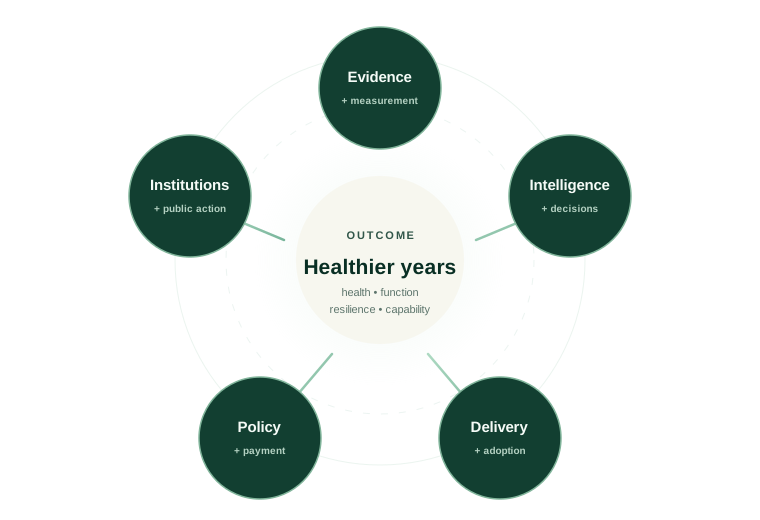
P4L combines public intelligence, evidence and proof, decision tools, operating frameworks, communications, relationships, institutional work, and an AI-ready discovery layer. Any one of these may be the useful P4L contribution within a larger effort.
The evidence → decision → adoption architecture and public capability map.
The first five builds and the broader system for healthier years.
Methods for evidence, uncertainty, AI use, and accountable public interpretation.
Briefing, measurement, coalition, mandate, and institution-building routes.
Ask P4L searches the published record index and returns source-linked records; it does not generate synthesized answers. Public data are available for citation and reuse.
Trusted connections and coordinated action built around the mission and the work required.
Prevention, healthspan, and longevity are often handled as separate conversations. P4L connects them—without collapsing their differences—because health is shaped across time, systems, institutions, and decisions.
P4L is being built as a founder-led institutional platform for the evidence, infrastructure, implementation, and collective action required to improve how long people live in good health.
Reduce avoidable risk, improve prevention delivery, act earlier when evidence supports it, and close the gap between recommendation and completion.
Protect the capacity to withstand, adapt to, and recover from disease, injury, stress, and age-related change.
Preserve function, cognition, mobility, independence, participation, and the ability to do what matters across the life course.
Translate healthspan and longevity science into outcomes, measures, delivery pathways, and responsible real-world benefit.
Healthcare transformation depends on connected changes in orientation, timing, information, decisions, and place.
These figures use different populations, years, and methods. Their denominators and limitations stay attached.
Population burden does not establish causality, preventability, intervention effectiveness, product performance, savings, or medical advice.
Scientific progress creates possibility. Public benefit depends on whether evidence can be interpreted, health can be measured longitudinally, useful innovation can be absorbed, delivery can be completed, incentives can align, and institutions can learn.
Clarify outcomes, evidence strength, uncertainty, safety, population fit, and the measures that distinguish longer life from longer healthy life.
Track research, regulation, reimbursement, technology, policy, market, and institutional signals in decision context.
Connect evidence to workflow, access, behavior, workforce, operations, follow-up, and accountable delivery.
Resolve the clinical, economic, governance, procurement, trust, technical, and organizational conditions that determine durable use.
Examine the incentives, standards, reimbursement, accountability, and public policy that determine what can scale.
Create shared language, coalitions, standards, communications, convening, and decision pathways for priorities no institution can move alone.
The launch release makes P4L's early operating layer visible: source-linked signals, evidence records, proof controls, decision tools, and machine-readable data.
A living view of the evidence, measures, technologies, payment pathways, workflows, safeguards, and institutional decisions required to move prevention and healthspan innovation into responsible use.
Users: health systems, payers and employers, policymakers, researchers, technology developers, funders and mission-aligned coalitions
Outputs: evidence briefs, measure and endpoint maps, adoption diagnostics, scenario analysis, decision briefs and monitored pathways
Intelligence and decision support do not establish clinical effectiveness, regulatory authorization, coverage, investment merit or guaranteed adoption.
Monitored pathways: ACCESS, TEMPO, Medicare App Library, PROSPR, XPRIZE Healthspan, digitally derived measures, AI-enabled care and other programs.
Open →LiveSignal RadarCurrent public records include verification dates and source links; high-volatility records are rechecked before consequential use.
Open →LiveEvidence ExplorerShows evidence design, source authority, applicability, confidence, freshness, and decision priority.
Open →LivePublic Proof LedgerSeparates sourced fact, P4L interpretation, and evidence limitations.
Open →LiveIntelligence GraphDisplays sourced and explicitly labelled inferred relationships.
Open →LiveDecision CenterSupports decisions with explicit requirements, owners, gates, and next questions.
Open →LiveAsk P4LAsk P4L searches the published record index and returns source-linked records; it does not generate synthesized answers.
Open →PilotAdoption DiagnosticPilot diagnostic for evidence, workflow, economics, governance, trust, and completion.
Open →PilotP4L BriefPilot edition connecting current signals, evidence, policy, payment, and institutional action.
Open →The model is one operating loop inside the larger mission. It makes transitions visible, assigns ownership, and turns each outcome into evidence for the next decision.
Track source-linked changes in policy, evidence, technology, payment and institutional action.
Open Intelligence →Inspect the claim, source, design, limitations, applicability and current review status.
Explore Evidence & Proof →Examine workflow, incentives, safeguards, authority, implementation and measurement.
Use the Adoption Diagnostic →Define the decision, missing capabilities, evidence boundary, governance and path to action.
Explore Work & Collaboration →Connect evidence, earlier action, delivery, access, incentives, measurement, and learning to preserve healthier years.
Explore the framework → Adoption frameworkIdentify why useful innovation stalls between evidence, institutional capability, workflow, payment, trust, and sustained use.
Explore the adoption test → Governance frameworkMake sources, uncertainty, interpretation, decision relevance, and human accountability visible.
Review the method →P4L does not become generic by serving people outside healthcare. Its focus remains prevention and healthier years; its value changes with the visitor’s role.
Connect evidence to prevention pathways, workflow, access, incentives, measurement, and completion.
Understand evidence boundaries, stakeholder decisions, real-world barriers, and the conditions for responsible use.
See where findings, measures, infrastructure, and resources could change real-world healthspan outcomes.
Use source-linked intelligence, shared language, convening, and implementation architecture to coordinate action.
Gain accurate context, stronger narratives, stakeholder insight, and responsible ways to shape public and institutional understanding.
Understand why prevention and healthspan developments matter, what the evidence supports, and where participation can help.
Stephen Phillips is a healthcare strategy, innovation, and transformation leader whose work spans surgical MedTech, clinical environments, health systems, commercialization, enterprise technology, technology adoption, and execution.
He founded P4L to advance a connected vision of prevention, healthspan, longevity, and healthcare transformation.
P4L is one connected part of Stephen’s broader work across healthcare innovation, proactive care, digital health and AI, healthspan, longevity, and system transformation.
P4L can contribute evidence, intelligence, communications, relationships, strategy, and implementation support—according to the work and the role P4L can responsibly play.